
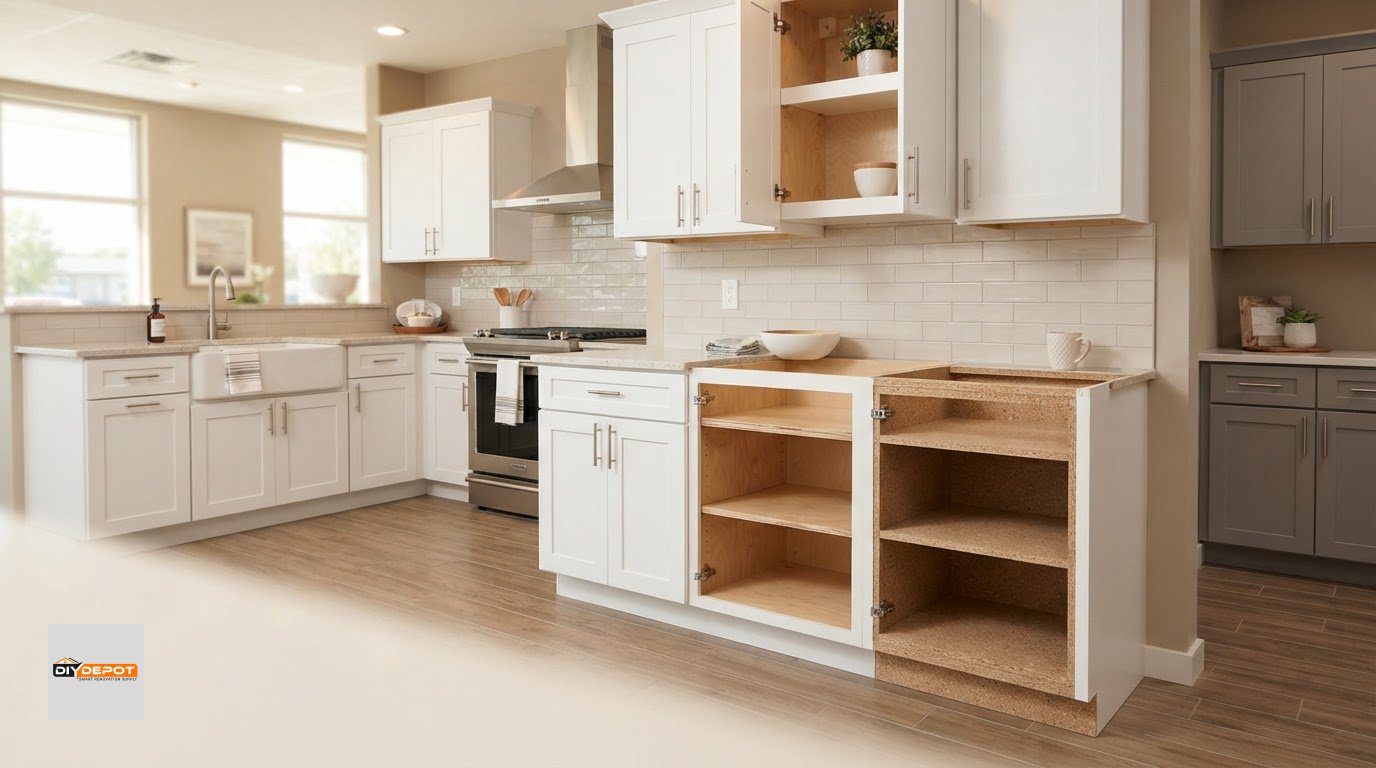
The cabinet material that costs less upfront isn’t automatically the better fit for your kitchen. Comparing plywood vs particle board cabinets can feel confusing when listings use broad labels, especially if you’re weighing everyday durability, moisture near the sink, and long-term value.
Both materials have trade-offs, and the label alone doesn’t tell the whole story. Plywood quality varies, and “plywood construction” may describe only some parts of a cabinet box. This guide explains how plywood and particle board are made, how their construction can affect different cabinet components, and what to compare when planning a kitchen. You’ll also get a practical way to assess product details alongside your layout, storage needs, and budget.
Key Takeaways
- Compare plywood and particle board by the specific cabinet component, not just the overall material label.
- Consider where cabinets will be used, including areas near the sink, dry storage, and frequently used drawers.
- When weighing plywood vs particle board cabinets, balance construction details and kitchen conditions with your budget and project priorities.
- Use a simple decision process: identify the component, assess its conditions, compare specifications, then weigh your priorities.
- Connect material choices with your layout, cabinet types, and style through DIY Depot’s professional kitchen design support.
Plywood vs. Particle Board Cabinets: What Are They Made Of?
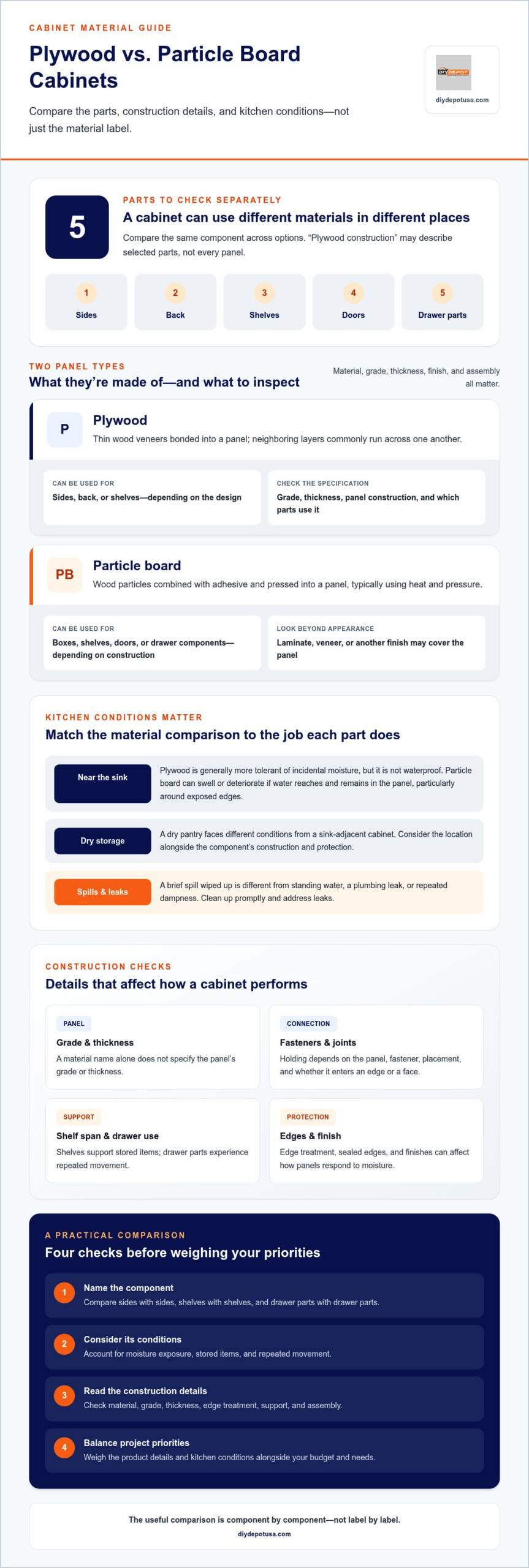
The material label alone doesn’t tell you whether a cabinet suits your kitchen. Plywood and particle board are made differently, and a single cabinet can use different materials in different parts. Start by finding out which component a product description is talking about.
Cabinet boxes, shelves, backs, doors, and drawer parts can each have their own construction. A listing might describe the box sides but say nothing about the shelves or drawer bottoms. That doesn’t automatically make the cabinet a poor choice. It means you should compare the same components across options, such as shelf material against shelf material, rather than assuming every panel is identical.
How plywood panels are constructed
Plywood is made by bonding thin sheets of wood veneer into a panel. In common plywood construction, the grain direction of neighboring layers runs across one another. This differs from a solid wood board, which is cut from a single piece of wood. The term “plywood” doesn’t guarantee a particular level of performance: grade, thickness, and panel construction all matter. For a fuller overview of its manufacture and uses, see What is plywood?
In a cabinet, plywood may be used for the sides, back, or shelves, depending on the design. The label alone won’t tell you the panel’s grade or thickness, or which parts use it. A useful product description identifies the components rather than relying on a broad material claim.
How particle board panels are constructed
Particle board is made from wood particles combined with adhesive and pressed into a panel, typically using heat and pressure. The particles are larger than the fine wood fibers used to make medium-density fiberboard, or MDF. These are distinct panel products, even though both are engineered from wood and adhesive. A listing that says “engineered wood” may not name the specific panel type, so look for the material description.
Depending on the cabinet’s construction, particle board may be used in boxes, shelves, doors, or drawer components. Its edges and surface can be covered with laminate, veneer, or another finish, so appearance alone may not reveal what’s inside. A visible panel edge can offer a clue, but the product specification is a more dependable way to identify the material.
This is why “plywood construction” needs context. It may describe selected parts while other components use particle board or a different panel. For a useful plywood vs particle board cabinets comparison, check the sides, back, shelves, doors, and drawer parts separately. That turns a broad label into details you can use to compare options.
How Plywood and Particle Board Behave in Everyday Kitchen Cabinets
A cabinet is a system, not a single panel. Sides carry connections, shelves support stored items, and drawer parts move repeatedly. The right comparison depends on the component and how it’s built. Panel thickness, support, edge treatment, and assembly can all affect performance, so a material name alone won’t predict the result.
Cabinet performance depends on construction details and the conditions each part faces. A shelf with adequate support has a different job from a cabinet side holding hardware. A panel exposed to an occasional wiped-up spill faces different conditions from one repeatedly exposed to dampness.
Durability, fasteners, and cabinet assembly
Panel quality and thickness matter, but so do the joints and the way the cabinet is assembled. Fasteners need suitable material and enough support to hold securely. Results can vary with the panel, fastener, placement, and whether the fastener goes into an edge or a face. A blanket claim that one material always holds screws better doesn’t describe every cabinet or connection.
Consider the component’s job. A shelf’s span and support influence how it handles stored items, while drawer parts experience repeated movement. Edge treatment and well-fitted joints also affect how panels hold together over time. When comparing plywood vs particle board cabinets, these details explain why two options with different material labels may still need a closer, component-by-component review.
Moisture, spills, and maintenance
Kitchen panels can encounter humidity, splashes, and cleaning, but that isn’t the same as a leak or prolonged water contact. Finishes and sealed edges can affect how a panel responds. Plywood is generally more tolerant of incidental moisture than particle board, but it isn’t waterproof. Particle board can swell or deteriorate if water reaches and remains in the panel, particularly around exposed edges. The exact response depends on the panel and its protection.
A brief surface spill that’s wiped up is different from standing water under a sink, a plumbing leak, or repeated dampness. Prompt cleanup is a sensible habit for either material. Follow the cabinet maker’s care guidance, and address leaks rather than relying on a finish or panel type to withstand ongoing exposure.
Consider the kitchen’s likely conditions along with each component’s construction. A sink-adjacent cabinet may face a different moisture risk from dry pantry storage; a frequently used drawer has different demands from a fixed panel. DIY Depot USA’s professional kitchen design support can help connect cabinet choices with your layout and project needs.
Plywood vs. Particle Board Cabinets: A Side-by-Side Comparison
A useful comparison looks beyond the panel name. Plywood and particle board differ in composition and may suit different priorities, but grade, thickness, finish, edge sealing, and assembly all affect how a cabinet performs. The best fit depends on the component and your project priorities.
| Factor | Plywood | Particle board | What to compare |
|---|---|---|---|
| Composition | Layers of wood veneer bonded together. | Wood particles combined with adhesive and pressed into panels. | Identify the actual panel type, not just a broad label like “engineered wood.” |
| Common applications | May be used in cabinet sides, backs, or shelves, depending on the design. | May also be used in boxes, shelves, doors, or drawer components. | Which specific parts use each material? |
| Potential strengths | Layered construction can offer a useful balance of stability and strength, depending on grade and thickness. | Can provide a consistent, smooth surface suited to finished panels. | How are the panel, edges, and joints finished and supported? |
| Potential limitations | Quality and performance vary by grade, thickness, and construction. | Can be vulnerable to swelling or damage if moisture reaches the panel and remains there. | What conditions will the component face, and how is it protected? |
| Cost consideration | Often the higher-cost option. | Often selected when keeping initial cost lower is a priority. | Does the difference make sense for the component and the overall project budget? |
Which comparison factors matter most?
Start with how the cabinet will be used. A shelf holding everyday dishes, a frequently opened drawer, and a panel in dry storage have different demands. Consider likely moisture exposure and your maintenance preferences, then compare the actual specifications. Keep the panel’s properties separate from the finish and the cabinet’s complete construction. A protective surface, sealed edges, solid support, and sound assembly each contribute to the result.
Why neither material is automatically the winner
A well-specified particle board panel may suit a dry, finished application, while plywood may appeal for a component where strength or incidental moisture tolerance is a priority. Neither label guarantees how the finished cabinet will perform. If a listing doesn’t identify panel thickness, grade, edge treatment, or which parts use the material, you may not have enough detail for a reliable comparison.
Use the table as a starting point, then weigh expected use, kitchen conditions, maintenance preferences, and budget together. The phrase plywood vs particle board cabinets describes a broad choice, not a single specification. Compare construction component by component and consider how it fits the overall cabinet plan. You can browse cabinet options as you plan your kitchen.
How to Choose Cabinet Materials for Your Kitchen Project
Start with the job each cabinet part needs to do. Instead of choosing by a material label alone, use a short sequence: identify the component, consider its location and use, compare the specifications, then weigh the trade-offs against your project priorities.
- Identify the component. Are you comparing a cabinet box, shelf, back, door, or drawer part? Keep the comparison focused on the same component in each option.
- Assess its conditions. Consider how often it will be used and whether it sits near a sink, appliance, or area where spills may occur.
- Compare the specifications. Look for the panel type, thickness, finish, edge treatment, and construction details.
- Weigh your priorities. Balance the intended use and care needs with your project budget and preferences.
Match the material question to the cabinet location
Location adds context, but it doesn’t dictate a single material choice. A cabinet beside a sink may face more splash risk than one used for dry pantry storage. A frequently opened drawer has different demands from a fixed back panel. Use these examples to focus on relevant conditions rather than assuming every cabinet in a kitchen needs the same construction.
Cabinet roles matter, too. Kitchen layouts can include base, wall, and other units, each with different components and functions. Compare like with like: a shelf in one cabinet against a shelf in another, not a shelf specification against a box-side specification.
Use a simple product-specification checklist
Product descriptions can use broad terms that leave out important details. Make a short record for each option so you can compare equivalent parts and finishes. Note whether a detail is stated, and keep unknowns separate rather than filling gaps with assumptions.
- Panel: Record the named material for the component you’re evaluating.
- Thickness and grade: Note these details when provided, since they describe the panel more precisely.
- Finish and edges: Compare the surface finish and how exposed edges are treated.
- Construction and assembly: Look for information about joints, support, and how the cabinet is assembled.
- Use and care: Consider the cabinet’s intended role and follow its care guidance.
Assembly is a separate buying factor from panel material. A cabinet’s construction details and assembly both contribute to the complete product, but one isn’t proof of the other.
For a plywood vs particle board cabinets decision, this process helps show whether the options are genuinely comparable. If you’re planning a kitchen and want to connect cabinet choices to your layout, book professional kitchen design support with DIY Depot USA.
Choosing Kitchen Cabinets with Practical Design Support
Material research is one part of a kitchen decision. Your plan also needs to account for the room’s layout, storage needs, cabinet types, finish, and how the pieces work together. A panel label can help you compare construction, but it can’t determine whether a cabinet arrangement suits your cooking habits or available space.
Consider the complete cabinet, not one panel label
Start with the practical questions your kitchen needs to answer. Where do you need space for everyday dishes, pantry items, cookware, or small appliances? Which cabinet locations need easy access? Once you have a rough plan, connect those uses to the cabinet types and components you’re comparing. A base cabinet has a different role from a wall cabinet, so the useful construction questions may differ too.
Bring material questions into that bigger picture. If a product description names a panel, note which part it refers to and how the finish and construction suit the cabinet’s intended role. For example, you may want to understand the construction of a cabinet near a sink while also considering how its storage fits the layout. The goal is to compare the cabinet you plan to use, not assume one material is right for every location.
Style is another part of the decision, but it doesn’t tell you what the cabinet box is made of. White Shaker and Grey Shaker are style options; neither name establishes the panel composition. Keep appearance and construction as separate questions so you can choose a look you like while evaluating the cabinet details on their own.
Move from comparison to a project plan
DIY Depot USA provides professional kitchen cabinet design support to connect cabinet choices with your layout and project priorities. Bring your room measurements, storage goals, and preferred style into the planning conversation, then consider how cabinet types fit together across the kitchen. This helps you plan a coordinated cabinet solution instead of focusing on one material comparison in isolation.
DIY Depot USA’s primary stocked style is White Shaker, with Grey Shaker as another option. Treat these as style choices, not evidence of a specific box material. For any cabinet, keep the questions clear: Which components are described? How does the cabinet fit the room and your storage needs? Which finish and style work with the overall plan? That keeps your plywood vs particle board cabinets research connected to practical decisions.
If you’re ready to bring your cabinet priorities and kitchen layout together, book an appointment for kitchen design support.
Turn Your Cabinet Research Into a Kitchen Plan
Your next step is to turn material preferences into a plan that suits the way you use your kitchen. Think about what matters most in the finished space, from storage and daily routines to the overall look, then use those priorities to guide your cabinet choices. The plywood vs particle board cabinets decision is most useful when it supports a complete plan rather than becoming a choice made in isolation.
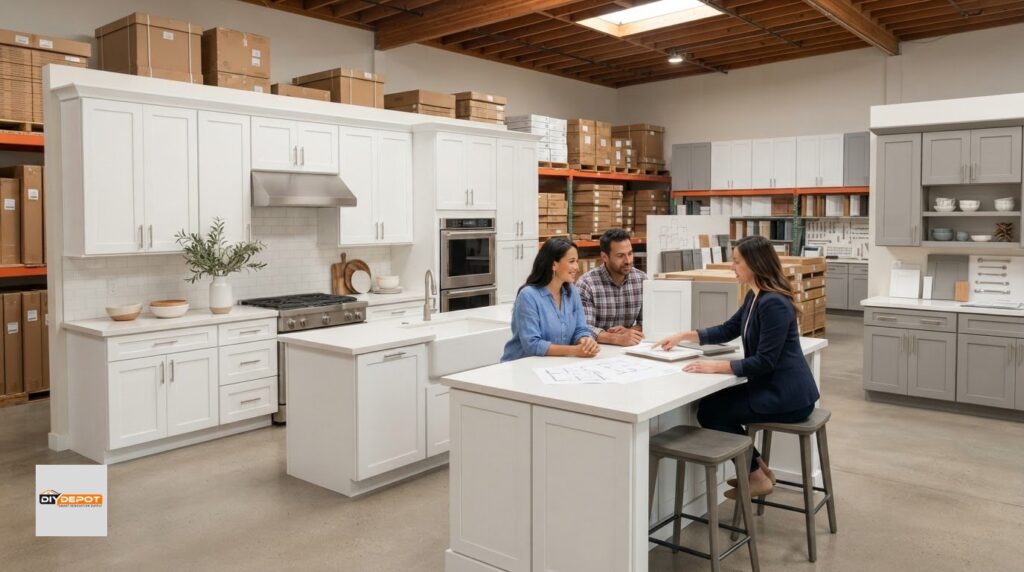
A clear plan can make it easier to compare cabinet options and keep your project focused. DIY Depot USA’s warehouse-direct approach gives you a practical place to explore kitchen cabinets as you shape that plan. You can start with the priorities you know, then refine the details as your project takes shape.
DIY Depot USA is based in Bakersfield and serves customers across California, including Fresno, Santa Maria, San Luis Obispo, Santa Barbara, Ventura, Visalia, Oxnard, Kern County, and Kings County, as well as Las Vegas and northwest Phoenix. Explore kitchen cabinets and plan your project with helpful design support.
Frequently Asked Questions
Is plywood always better than particle board for kitchen cabinets?
No. Plywood can be a strong choice for some cabinet parts, but its grade, thickness, joints, and intended use matter. Particle board may suit a finished component in a dry location, particularly when cost is a priority. For plywood vs particle board cabinets, compare the same component in each option and consider the kitchen conditions it will face. A material name alone can’t establish which cabinet is the better fit.
Can particle board cabinets hold up in a kitchen?
Yes, particle board cabinets can serve in kitchens when their construction suits the intended use and they’re cared for appropriately. A finished panel in a dry storage area, for example, may face different demands from a cabinet under a sink. Check how edges and surfaces are protected, avoid leaving spills or dampness unattended, and follow the cabinet maker’s care instructions. Good everyday habits help protect cabinets made from wood-based panels.
What is the difference between particle board and MDF cabinets?
Particle board is made from wood particles bonded into a panel, while medium-density fiberboard, or MDF, is made from finer wood fibers and adhesive. Both are engineered wood products, but the names describe different panel materials. In a cabinet listing, look for the specific term rather than treating “composite wood” as a precise identification. The panel’s finish and intended application also matter, so compare those details alongside the material name.
Which cabinet material handles moisture better?
Plywood generally handles incidental moisture better than particle board, but neither should be treated as waterproof. A finished panel may resist brief splashes differently from an exposed edge, and prolonged dampness or a leak can damage either material. Near plumbing, pay attention to the cabinet’s exposed surfaces and inspect for signs of a leak. Wipe up spills promptly and use the care guidance supplied for the cabinet.
How can I tell what material a cabinet box is made from?
Look for a product specification that names the material for each cabinet component, not just a headline such as “plywood construction.” The sides, back, shelves, and drawer parts may not all use the same panel. Keep the exact cabinet description with its construction details as you compare options. If the listing only says “engineered wood,” it doesn’t identify whether the panel is plywood, particle board, or another material.
Does plywood or particle board make cabinets more expensive?
Plywood is generally the higher-cost material, while particle board is often chosen to help manage the initial project budget. Compare equivalent cabinets rather than a single price label: size, which components use each panel, finish, and assembly can all affect the overall comparison. A lower initial cost may suit your priorities, while another project may place more value on particular construction details. Consider the full cabinet, not only its box material.
What cabinet materials should I compare near a sink?
Compare the materials used in the sink-base sides, bottom, back, and nearby panels, along with the finish and treatment of exposed edges. Those parts can face different conditions, so don’t assume one material description covers the whole cabinet. Account for normal splashes separately from a plumbing leak or standing water. DIY Depot USA provides professional kitchen design support for homeowners in California, including Bakersfield, Fresno, Santa Maria, San Luis Obispo, Santa Barbara, Ventura, Visalia, Oxnard, Kern County, and Kings County, as well as Las Vegas and Phoenix.