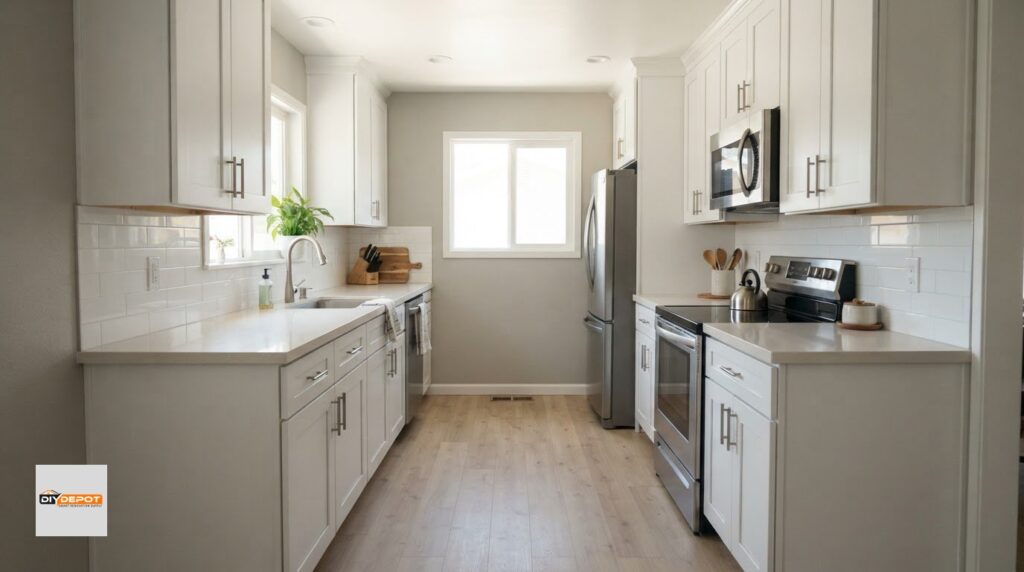

A cabinet can look polished and still be poorly made. Knowing how to spot poorly made cabinets means looking beyond the door style: inspect the cabinet box and joints, operate the drawers, and examine the hinges, finish, and edge banding. These details tell you more about everyday performance than appearance alone.
It’s easy to focus on color, hardware, and modern features when choosing cabinets. Those choices matter, but sound construction helps cabinets feel sturdy and function smoothly through daily use. Check the materials and joinery, see how drawer slides and adjustable hinges work, and look for finish or edge details that may signal weak workmanship.
We’ll also explain how to weigh construction against added features, so you can assess the whole cabinet rather than judge it by one attractive detail. A few practical checks can help you make a more informed choice for your kitchen or renovation.
Key Takeaways
- Judge cabinet quality by the materials and how the parts are joined, not by material type alone.
- Look past modern features and assess whether the cabinet’s underlying construction feels sturdy and well-fitted.
- Notice whether drawers move smoothly and hinges allow doors to align neatly.
- Inspect finishes and edge banding for peeling, chipping, roughness, or uneven coverage.
- Use signs such as misaligned doors, damaged surfaces, and flimsy drawer support to spot potential construction problems.
1. How Can You Tell If Kitchen Cabinets Are Good Quality?
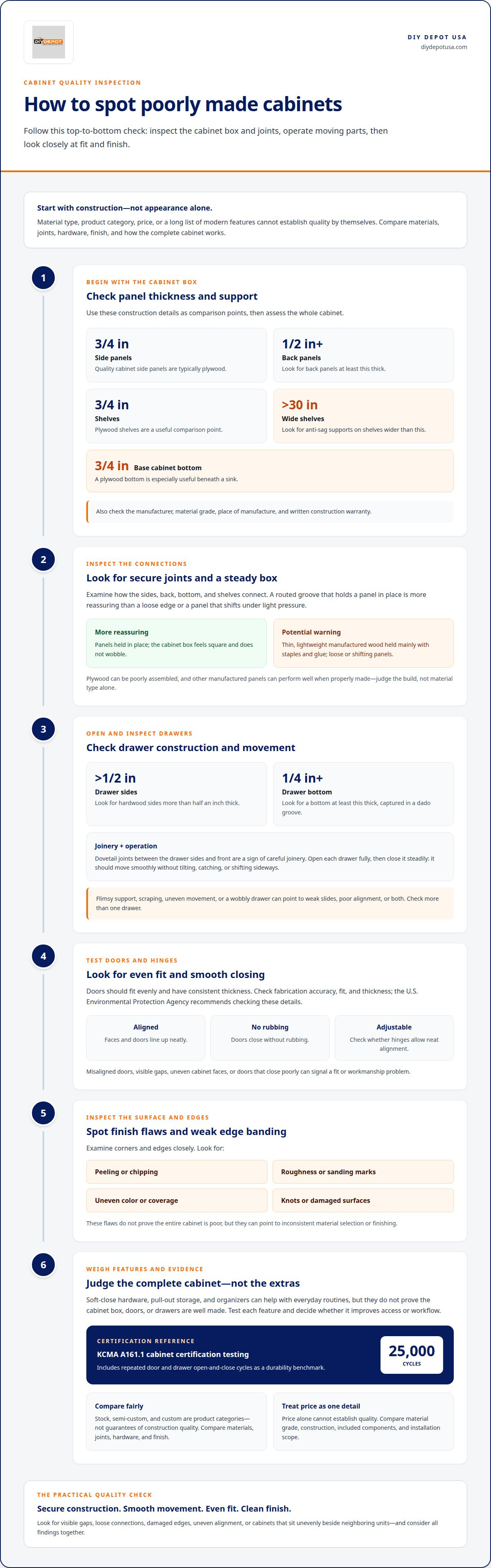
Start with the cabinet box, then inspect its joints, drawers, doors, and finish. Material alone doesn’t determine quality: plywood can be poorly assembled, while other manufactured panels can perform well when properly made. Check the manufacturer, material grade, place of manufacture, and construction warranty to understand what you’re evaluating.
Look at the box’s thickness and support. Quality cabinet side panels are typically 3/4 inch plywood, while back panels should be 1/2 inch or thicker. Shelves should be 3/4 inch plywood, with anti-sag supports on shelves wider than 30 inches. A base cabinet bottom made from 3/4 inch plywood is especially useful beneath a sink.
Use these as comparison points, not substitutes for examining the whole cabinet. Inspect how the sides, back, bottom, and shelves connect. A routed groove that holds a panel in place is more reassuring than a loose edge or a panel that shifts under light pressure. Thin, lightweight manufactured wood held mainly with staples and glue can signal a weaker build.
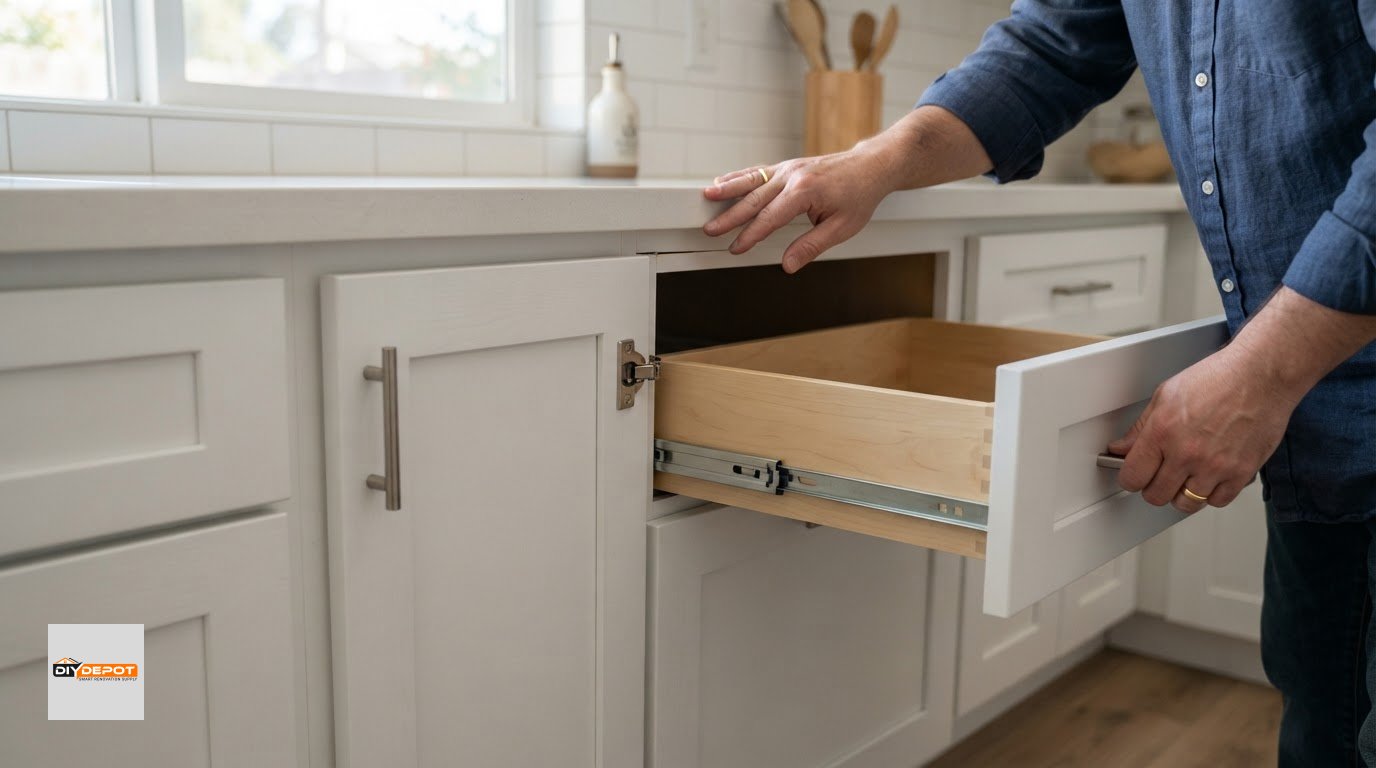
Drawers reveal construction details that cabinet doors can hide. Look for hardwood drawer sides more than half an inch thick, and a drawer bottom at least 1/4 inch thick, captured in a dado groove. Dovetail joints between the drawer sides and front are a sign of careful joinery. Check that the box feels square and doesn’t wobble when opened.
Cabinet doors should fit evenly and have consistent thickness. The U.S. Environmental Protection Agency recommends checking doors for fabrication accuracy, fit, and thickness. Inspect corners and edges for sanding marks, knots, chipped surfaces, or uneven color. Those flaws don’t prove the entire cabinet is poor, but they can point to inconsistent material selection or finishing.
How do poorly made cabinets compare with stock, semi-custom, and custom cabinets? Those labels describe product categories, not construction quality. Compare each cabinet’s materials, joints, hardware, and finish: a poorly built unit can disappoint at any level.
What cabinet warranties and construction standards should buyers look for? Review the written construction warranty and its coverage, then look for a stated construction standard. KCMA A161.1 cabinet certification testing includes 25,000 door and drawer open-and-close cycles, offering a useful durability benchmark.
What is a reasonable price for cabinets by quality level? Price alone can’t establish quality. A useful comparison considers material grade, construction, included components, and installation scope. Compare equivalent specifications rather than assuming a higher price means stronger cabinets.
2. Cabinet construction versus modern features
A kitchen can look beautiful while its cabinets struggle with everyday use. Features such as soft-close doors, pull-out storage, and built-in organizers can make routines easier, but they don’t show how well the cabinet box, doors, and drawers are made. Consider each feature separately, then assess whether the cabinet feels sturdy and works smoothly.
Use a simple order when evaluating a display or cabinet sample: inspect the basic construction, operate the moving parts, and then consider the extras. A soft-close drawer should close evenly without sticking or slamming. A pull-out organizer should move freely and stay aligned. If a feature works poorly before installation, a simpler design that operates reliably may be more useful.
Certification testing offers one reference point. KCMA A161.1 cabinet certification testing includes 25,000 door and drawer open-and-close cycles. That test focuses on repeated operation, which helps distinguish demonstrated performance from a feature’s appearance. Certification doesn’t replace examining fit and workmanship, but it gives you a clearer basis for discussing durability.
Consider how each feature affects access. A pull-out tray can make items at the back of a base cabinet easier to reach, while an organizer can separate kitchen items. Ask whether each addition solves a real storage or workflow problem. A feature that adds complexity without improving access may not be worth prioritizing.
Compare two cabinets with similar styling. One may have added organizers but uneven doors or drawers that scrape. Another may offer fewer extras while opening and closing cleanly. Treat those differences as evidence: attractive features are worthwhile when they work as intended and don’t distract from poor fit, unstable movement, or visible defects.
Make a short decision record for each option. Note the cabinet’s construction and any certification, then list the features you’ll use regularly. Test every door, drawer, and pull-out more than once, watching for uneven movement or unexpected resistance. This keeps the comparison focused on function and construction, rather than letting a polished display or long feature list decide for you.
For a kitchen renovation, aim for balance: choose conveniences that suit your routine, while treating sound construction and smooth operation as essential. A modern feature can improve access or ease of use, but it can’t compensate for a cabinet that feels unstable or works poorly. Evaluate the complete cabinet, not just the details designed to catch your eye.
3. Drawer slides and hinge adjustability
Drawer slides and hinges affect how cabinets feel in everyday use. Open each drawer fully, then close it at a steady pace. It should move smoothly without tilting, catching, or shifting sideways. Uneven movement may point to weak slides, poor alignment, or both. Check more than one drawer, since a single smooth example doesn’t show how the whole set performs.
Look for two side-mounted slides supporting each drawer. Flimsy or missing slides can leave a drawer unsupported and make it harder to open when loaded. Full-extension slides let a drawer travel farther out, improving access to items at the back. Treat ratings as product details, not proof of quality by themselves.
During a remodel, inspect the drawer’s path as well as its hardware. Pull it out and see whether both sides extend evenly. Listen for grinding or rattling, and notice whether the drawer drops at the front. A drawer that rubs against the cabinet or sticks near the end of its travel needs attention. Test it again after closing: a smooth opening alone doesn’t prove the mechanism returns properly.
Adjustable hinges help cabinet doors sit evenly against the face frame. Six-way adjustable hinges allow movement up and down, left and right, and in and out. That range helps correct small alignment differences and maintain consistent spacing between neighboring doors. Open and close several doors, then compare their edges. Gaps should look consistent, and doors shouldn’t collide or sit noticeably proud of the surrounding frame.
Check whether an adjustment changes the door’s position without making it bind. A hinge that adjusts in only one direction can make it difficult to correct a door that shifts vertically and outward. Inspect the hinge connection, too. Loose screws, bent parts, or a door that sags after opening suggest the hardware or its attachment isn’t holding securely.
Try a practical test: open one drawer fully, close it, and repeat with another. Then open two neighboring doors and check their alignment when shut. Smooth travel, stable support, and adjustable hinges make everyday use easier. A cabinet with misaligned doors, scraping drawers, or weak slide support deserves closer inspection, even if its hardware looks modern.
4. Finish quality and edge banding
Inspect the finish in bright, even light before deciding whether a cabinet looks well made. View each door from the front, then look across its surface at an angle. Uneven sheen, rough patches, visible sanding marks, or inconsistent color can point to rushed preparation or application. Gently run your fingers along an exposed edge; it should feel smooth, not sharp, rough, or unfinished.
Look closely at corners, door edges, and areas around pulls. These spots show wear quickly in everyday kitchen use. Check for chips, bubbles, peeling, or a finish that looks thin near an edge. One small flaw may be isolated, but repeated problems across several doors suggest inconsistent workmanship. Compare matching doors side by side for similar color and coverage.
Edge banding covers the exposed edges of cabinet panels. Examine it where shelves, doors, or cabinet sides meet. The strip should sit flat and evenly along the panel, with no raised seams, gaps, or loose corners. Thin melamine edge tape is typically 0.3mm to 0.5mm thick and prone to peeling and chipping. For quality cabinet panels, recommended edge banding is 1mm to 2mm thick.
Thickness is only one part of the inspection. Check that the banding is firmly attached and its color and texture match the visible panel. Press lightly along an edge; a loose section or lifting corner can collect dirt and moisture. On a shelf, inspect the front edge as well as the sides, since repeated contact with dishes can expose weak or damaged covering.
What problems can result from poorly made cabinets, such as sagging or peeling? Weak edge covering can peel or chip, exposing the panel core, while a weak shelf may sag under stored items. Flaking surfaces may also indicate photo-simulated wood grain made from pressboard and paper.
During a kitchen remodel, inspect cabinet interiors as carefully as the visible fronts. Check the underside of shelves and edges hidden beside neighboring cabinets. Less visible areas can reveal unfinished surfaces, loose banding, or inconsistent coating. Look inside a base cabinet near plumbing, where leaks can make swelling or lifting easier to spot.
Distinguish a cosmetic imperfection from a construction concern. A slight color variation may affect appearance, while peeling banding exposes an edge to further damage. Record where each issue appears across the cabinet set. Repeated chips on several doors or loose edging on multiple shelves provide a clearer quality signal than one isolated mark.
Follow a consistent check: view the surface in angled light, inspect corners and edges, then test for loose or rough sections. Compare similar panels rather than judging one door alone. This quick process helps reveal whether the finish is even and the edge banding secure, beyond the color or style shown in a display.
5. What are signs of poorly made kitchen cabinets?
Start with the visible surfaces, then inspect the cabinet interiors. Flaking or peeling material can reveal photo-simulated wood grain made from pressboard and paper. Excessive wear on door fronts and around drawer pulls also signals trouble, especially when nearby areas show little use. Check several doors and drawers: repeated damage points to a broader quality concern, not one isolated mark.
Misaligned doors and drawers are another warning sign. Check whether neighboring doors sit evenly and drawer fronts line up when closed. A door that rubs, hangs crooked, or leaves an inconsistent gap makes the cabinet harder to use. Look for missing cabinet faces, too. Exposed openings can leave the interior vulnerable and may indicate that parts have detached or deteriorated.
Inside the cabinet, examine how the floor meets the side panels. The floor should fit into a routed side panel rather than appear loosely attached at the edges. Check the door panels, too. Panels fitted into deep, lightly padded grooves can expand and contract with humidity without cracking or warping. A panel glued or fastened rigidly into its frame can be more vulnerable to those changes.
Shelves offer another useful clue. They should be adjustable and supported by metal brackets, not plastic ones. Check that brackets sit firmly in their holes and shelves rest evenly without rocking. A shelf that sags under ordinary stored items or shifts when touched can make everyday use less reliable. Inspect the support points, not just the visible front edge.
Follow a consistent inspection path: view the fronts, open each door and drawer, then check the interior floor, shelves, and frame. Note whether the same defect appears in several places. One crooked door differs from a row of misaligned fronts paired with loose shelves and damaged interiors. A cluster of problems gives a clearer picture of cabinet condition and helps distinguish surface wear from deeper structural damage.
Before deciding what to do with aging cabinets, separate repairable surface issues from a failing structure. Missing faces or worn pulls are visible, while swelling and mold affect the cabinet interior. That distinction matters because a new appearance cannot fix a cabinet box that is already deteriorating.
DIY Depot
DIY Depot can help you move from spotting cabinet problems to planning a replacement. Based in Bakersfield, it offers Base Shaker Cabinets, Vanity Shaker Cabinets, and Wall Shaker Cabinets for different spaces in the home. Professional kitchen design support can help shape a plan around layout, storage, and cabinet choices, keeping practical needs central.
Use the checks in this guide to clarify your priorities, such as cabinet fit, daily function, or a consistent look. That gives you a clearer starting point for planning a renovation.
Contact DIY Depot to discuss your cabinet plans.
Make Your Next Cabinet Choice With Confidence
Knowing how to spot poorly made cabinets can shape more than a purchase. It helps you set priorities for your next kitchen or home project, from the look you want to how each space needs to function. Carry those priorities into your planning, and choose cabinets that suit the room rather than chasing features that don’t serve your everyday needs.
DIY Depot USA offers Base Shaker Cabinets, Vanity Shaker Cabinets, and Wall Shaker Cabinets for different spaces in the home. If you’re weighing renovation options, that range gives you a practical place to start considering how cabinet style fits your plans.
Contact DIY Depot to discuss your cabinet plans and take the next step with confidence.
Frequently Asked Questions
How Can You Tell If Kitchen Cabinets Are Good Quality?
Good-quality kitchen cabinets combine suitable materials, careful construction, and parts that work consistently. Learning how to spot poorly made cabinets means evaluating the whole unit, not just its finish or material label. Compare how securely the panels connect, whether doors sit evenly, and whether the interior feels finished. Manufacturer details and a written construction warranty can add useful context when comparing similar options.
How can you check cabinet construction quality in person?
Inspect a cabinet from the outside in, using a phone light to see darker interior corners. To understand how to spot poorly made cabinets, look for loose connections, unfinished edges, panel gaps, or swelling near plumbing. Gently press a shelf and the cabinet back to notice movement, but don’t force the unit. Then open and close the doors and drawers, checking their movement and alignment.
What materials indicate low-quality cabinets, such as particleboard or MDF?
No single material label proves a cabinet is poorly made; material grade and construction matter, too. A thin, lightweight panel with loose joints, exposed edges, or a flaky, paper-like surface deserves closer scrutiny. Particleboard or MDF alone doesn’t tell you how well a cabinet will perform. Compare panel thickness, edge protection, and how securely the parts are assembled before drawing conclusions.
How can you tell whether cabinet doors and drawers are built well?
Check whether doors have consistent thickness and sit evenly beside neighboring doors. Open each one to look for loose frame joints, rough edges, or panels that shift inside the frame. For drawers, see whether the box stays square as it moves. A drawer that twists, rubs against its opening, or separates at a corner may reveal weak construction, even if its front looks polished.
What should you inspect in cabinet hinges, drawer slides, and hardware?
Operate every door and drawer rather than testing only the easiest one. Check that hinges and slides stay firmly attached, move without scraping, and hold their alignment after repeated use. See whether handles and knobs wobble during ordinary use. For a practical comparison, open a drawer fully, close it, then repeat with a neighboring drawer; inconsistent movement can reveal a hardware or installation issue.