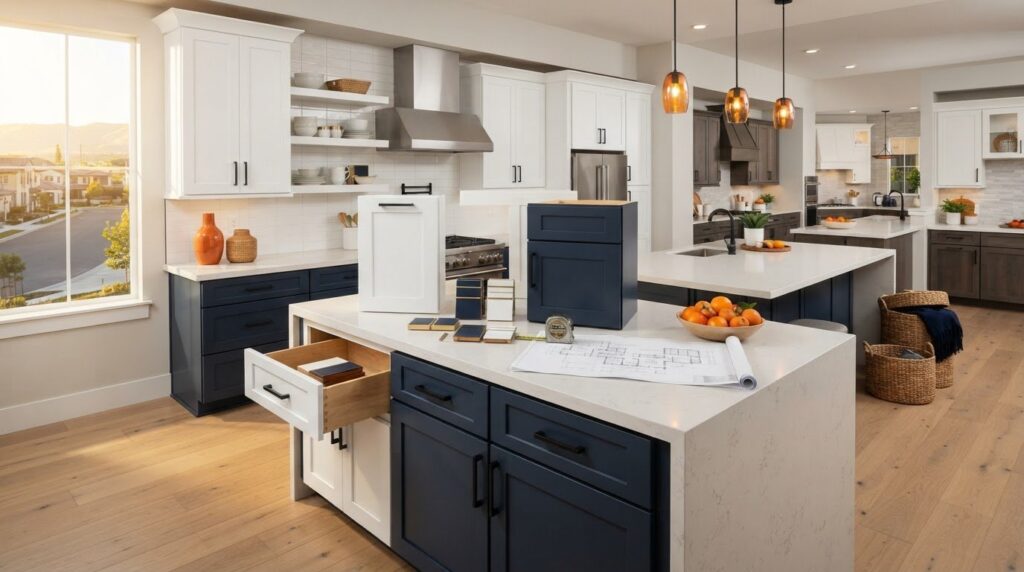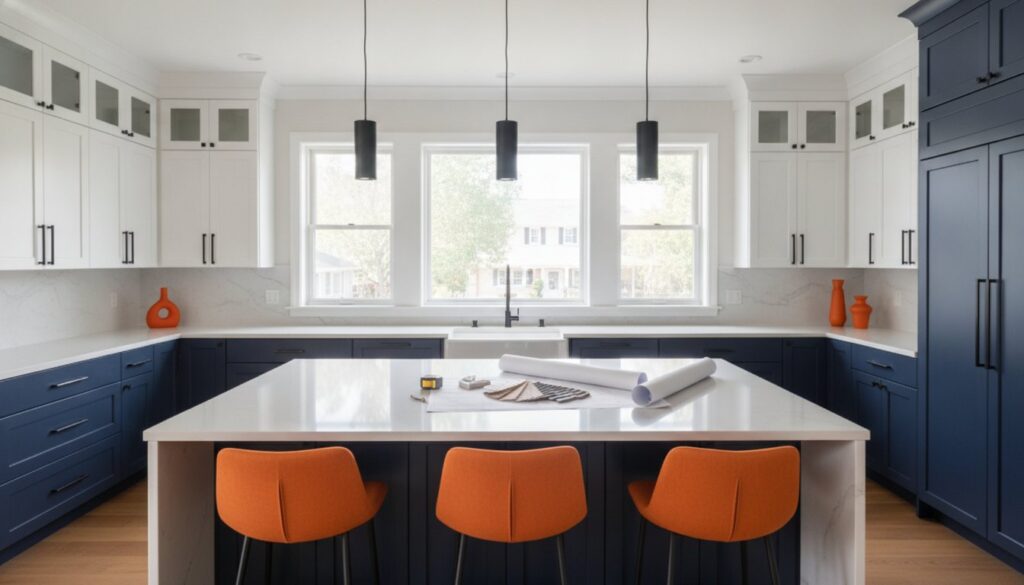

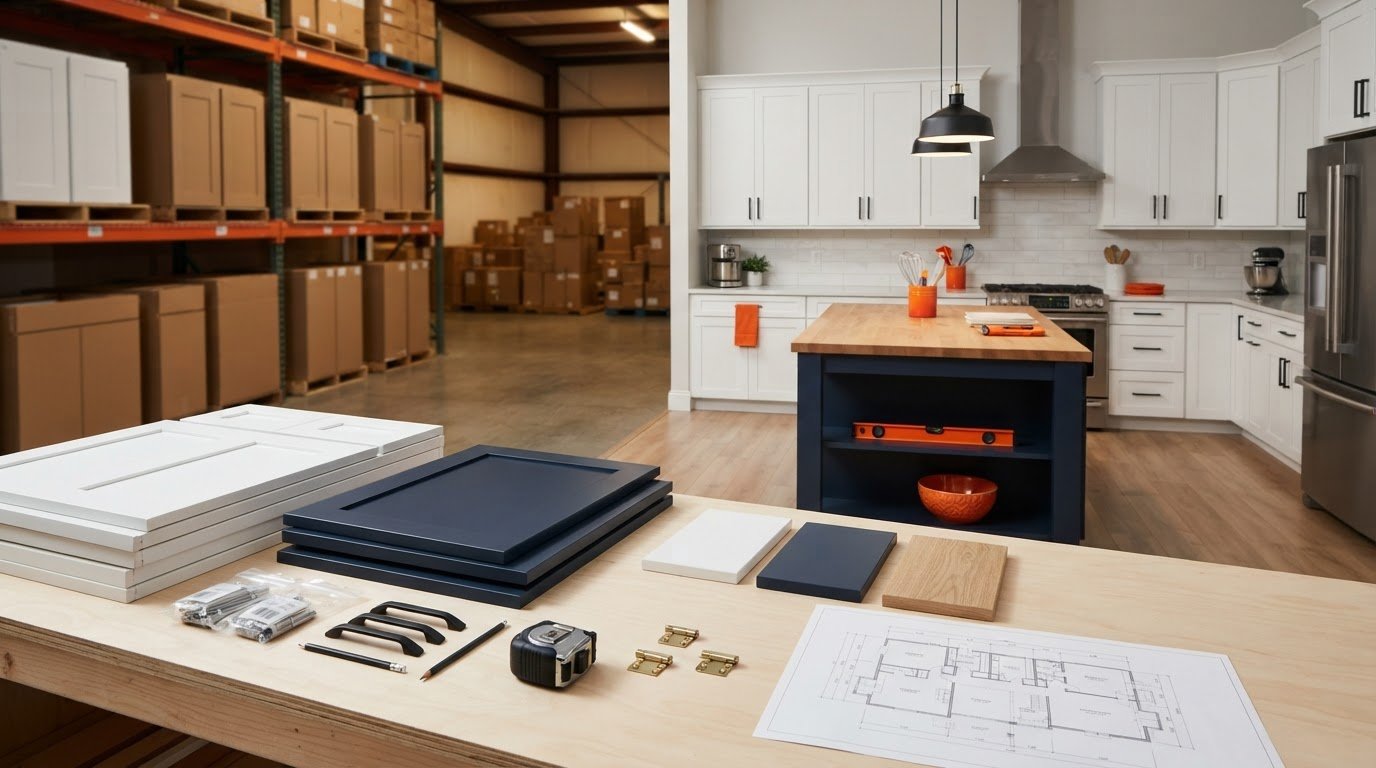
What if you could get shaker cabinets at warehouse-direct prices without overlooking materials, fit, or the support your project needs? That’s the promise of a well-chosen wholesale cabinet supply: a way to compare value and plan your purchase with care. It’s reasonable to be cautious. A lower price doesn’t help if the cabinets don’t suit your space, and buying in bulk can feel daunting without design support.
In this 2026 guide, you’ll learn how to compare cabinet quality, understand the ready-to-assemble (RTA) process, and evaluate savings alongside durability and fit. You’ll also see how professional kitchen design can help turn measurements and preferences into a practical plan.
We’ll cover what to check in shaker cabinets, how warehouse-direct purchasing may affect the price, and what support may be available if you’d rather leave assembly or installation to professionals. With base, wall, and vanity shaker cabinets, plus design assistance, a wholesale purchase can be a considered step toward a better-planned room.
Key Takeaways
- Understand what wholesale cabinet supply can mean for your renovation budget and what to check before choosing a supplier.
- Compare cabinet construction and hardware to assess value, not just the upfront price.
- Weigh the potential savings of ready-to-assemble cabinets against the time and effort of building them.
- Use accurate measurements and design support to plan the layout before ordering.
- Explore how DIY Depot USA combines warehouse-direct shaker cabinets with design, assembly, and installation support.
What is Wholesale Cabinet Supply and Why Does It Matter?
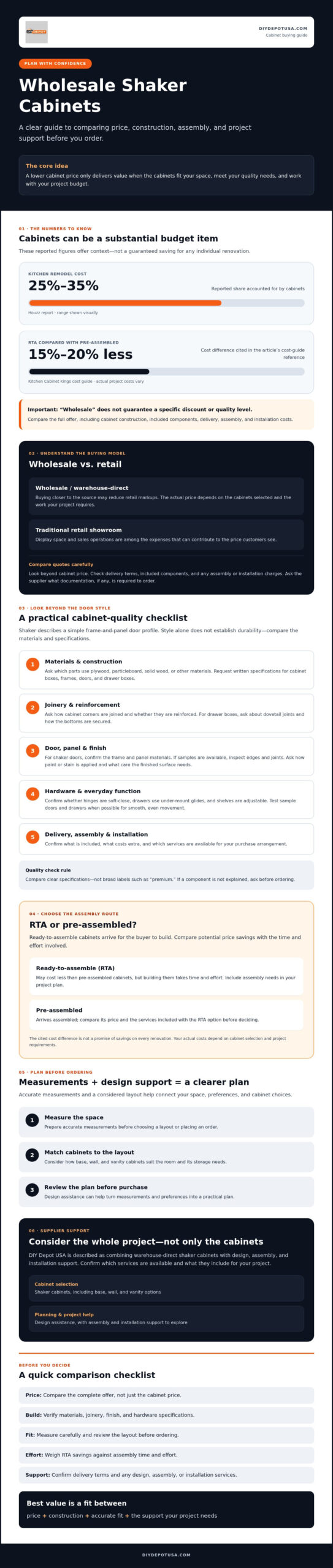
Wholesale cabinet supply generally means buying cabinets through a supplier that sells closer to the source, rather than through a traditional retail showroom. The model may reduce retail markups, but “wholesale” doesn’t guarantee a specific discount or quality level. Compare the full offer: cabinet construction, included components, delivery terms, and any assembly or installation costs.
Cabinetry can take a substantial share of a kitchen budget. Houzz reports that cabinets account for 25% to 35% of a kitchen remodel’s total cost. Ready-to-assemble (RTA) cabinets can cost 15% to 20% less than pre-assembled cabinets, according to Kitchen Cabinet Kings’ 2026 cost guide. These figures aren’t a promise of 30% to 50% savings on every renovation. Your actual costs depend on the cabinets selected and the work your project requires.
Wholesale buyers don’t necessarily need to assume they must hold a contractor license. Requirements can depend on the seller and purchase arrangement, so ask the supplier what documentation, if any, is needed to place an order. Wholesale is a purchasing model, not a substitute for checking the terms before you buy.
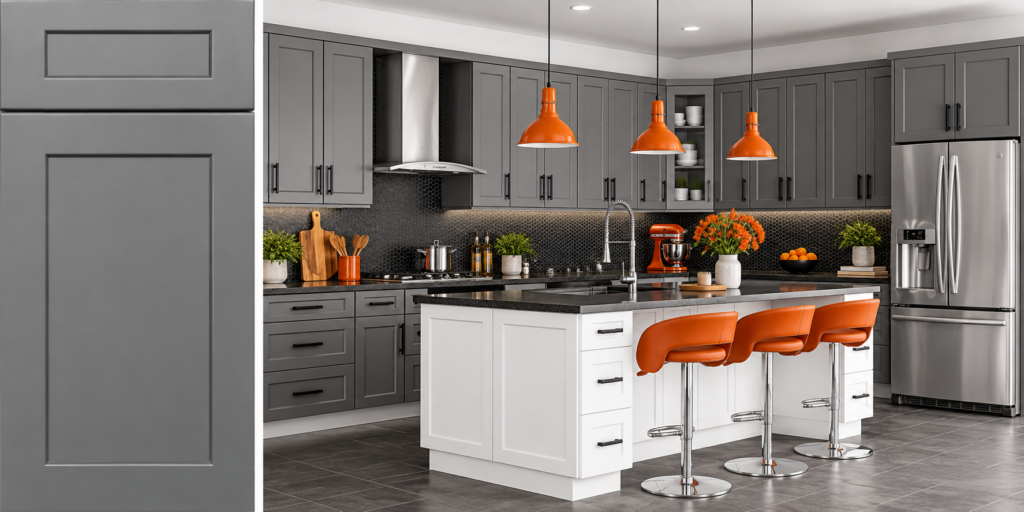
For a useful overview of cabinet types and construction, see Cabinetry. One familiar option is the shaker style. Its simple frame-and-panel door has broad design appeal, but the style alone doesn’t establish durability. Materials, joinery, hardware, and finish all matter when assessing a cabinet.
Wholesale vs. Retail: Breaking Down the Price Gap
Retail showrooms have operating expenses, including display space and sales operations, that can contribute to the price customers see. A direct-to-consumer wholesale model aims to reduce the distance between supplier and buyer, which may lower markups. For anyone balancing several renovation costs, warehouse-direct pricing may help preserve budget flexibility. Compare quotes carefully, including delivery and assembly, rather than judging by cabinet price alone.
The Shaker Style: Why It’s Common in Wholesale Supply
Shaker cabinets pair a straightforward door profile with a look that works in both traditional and modern kitchens. Their uncomplicated design also suits repeatable manufacturing, making the style a practical option for wholesale supply. Still, a timeless appearance and efficient production aren’t proof of stronger construction. Check the cabinet’s materials and specifications to evaluate quality.
Key Criteria for Evaluating Wholesale Cabinet Quality
A low wholesale price only delivers value if the cabinets suit your space and project. Look beyond the door style and ask for clear product specifications. Compare the box material, door and drawer construction, hardware, finish, and reinforcement details across options. If a supplier can’t explain what a component is made of, ask before ordering rather than assuming all cabinets in the same price category are built alike.
Plywood and particleboard are different panel materials, so don’t rely on a broad label like “premium.” Ask which cabinet parts use each material, and request written specifications. Also check how corners are joined and whether they’re reinforced. Those details help you compare construction consistently, especially when evaluating several wholesale cabinet supply options.
Identifying Shaker Cabinet Construction
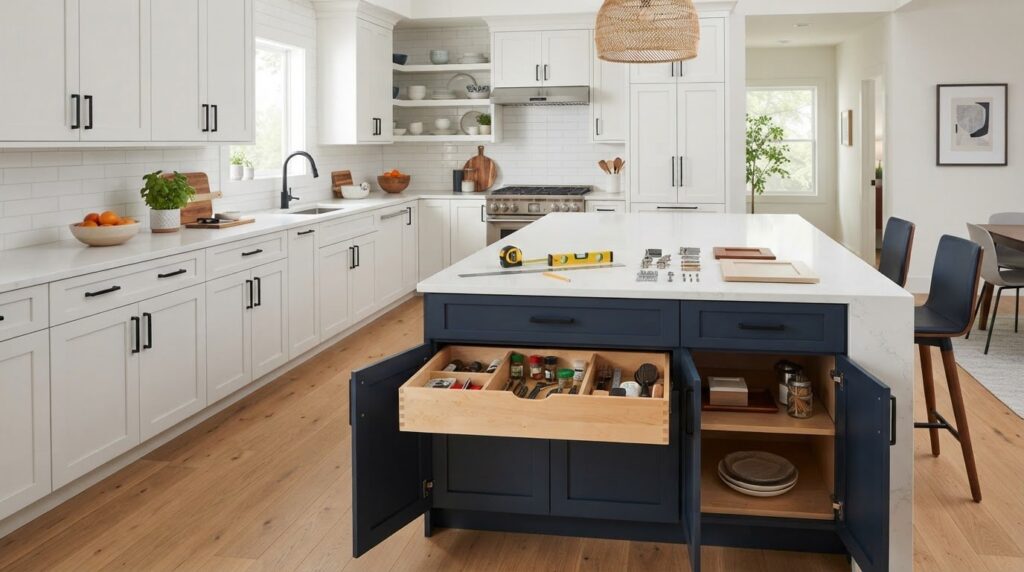
For shaker doors, ask whether the frame is solid wood or another material, and how the panel is made. Inspect sample edges and joints if samples are available; a smooth finish can hide construction details. Ask whether drawer boxes use dovetail joinery and how their bottoms are secured. Dovetail joints are interlocking, angled cuts that join drawer sides and are often treated as a hallmark of premium wholesale cabinetry.
Finish matters as well. Ask whether paint or stain is applied in multiple steps and what care the finished surface requires. Check that the coating looks even across faces and edges. Follow the supplier’s care instructions to avoid damaging the surface during cleaning.
Hardware and Functional Features to Check
Hardware affects daily use, so check the actual features rather than assuming they’re included. Ask whether hinges are soft-close and whether drawers use under-mount glides. Test doors and drawers on a sample if possible: listen for smooth, controlled movement and check that drawers track evenly. Ask whether shelves are adjustable and how they’re supported, since flexible shelf placement can accommodate different storage needs.
- Materials: Get written details on panels, frames, and drawer-box construction.
- Joinery: Ask how cabinet corners and drawer joints are assembled.
- Finish: Check application details and cleaning guidance.
- Hardware: Confirm hinge and glide features, and test movement when possible.
Specifications can vary by cabinet, so confirm details for the exact shaker cabinets you’re considering. To compare styles and available options, browse DIY Depot USA’s shaker cabinets.
RTA vs. Pre-Assembled: Maximizing Your Renovation Budget
Ready-to-assemble (RTA) cabinets arrive in parts for assembly on site, while pre-assembled cabinets arrive built. RTA can suit a renovation budget, especially when you have time and a suitable workspace. Kitchen Cabinet Kings’ July 2026 guide reports that RTA cabinets cost 15% to 20% less than pre-assembled cabinets. Treat that as a general comparison, not a guaranteed saving on a specific order.
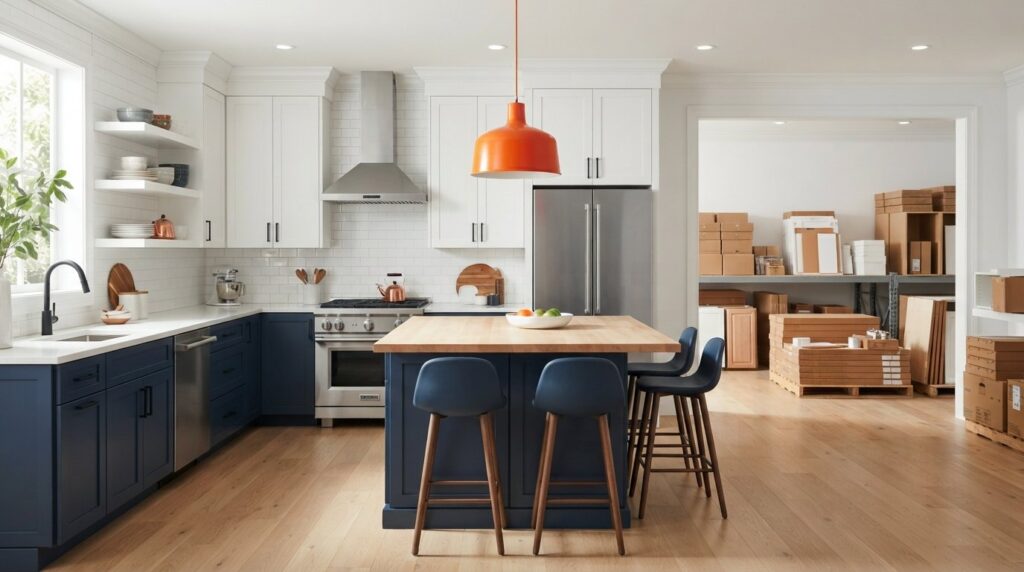
Flat-packed components take up less space in transit than assembled cabinet boxes, which can simplify shipping logistics. Pre-assembled cabinets may have greater exposure to shipping damage, according to the research for this guide, but packaging and handling still matter. Ask suppliers how cabinets are packed and what to do if an order arrives damaged.
The RTA Savings Framework
Compare the RTA discount with the time and effort assembly will require. Start with the difference between the RTA and pre-assembled quotes, then consider how many cabinets you’ll build and whether you’ll assemble them yourself or pay for assembly. The research brief estimates 10 to 20 minutes per cabinet after the first one, though actual time can vary with cabinet type and experience. DIY assembly is only a saving if the time and labor fit your project.
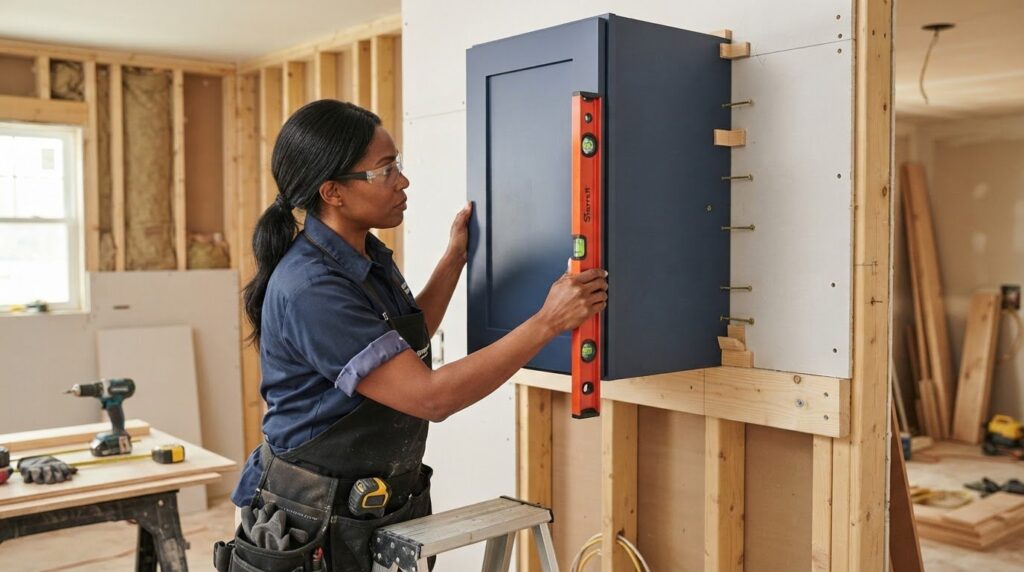
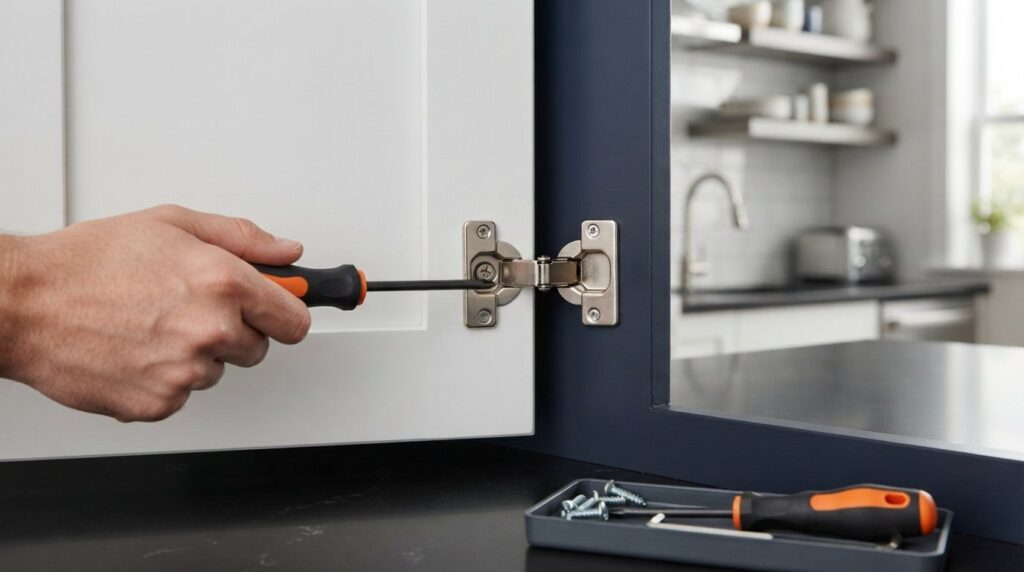
Set up a clean, level workspace and follow the cabinet maker’s instructions. A drill or screwdriver, measuring tape, square, and clamps are commonly useful, but check the supplied directions for the tools required. Keep hardware organized and assemble one cabinet at a time. If you prefer less hands-on work, DIY Depot USA offers assembly of its shaker cabinets.
When to Choose Pre-Assembled Cabinets
Pre-assembled cabinets can make sense when you need to reduce on-site assembly tasks or have little time to build cabinet boxes. They may also suit larger projects where coordinating assembly labor is difficult. Don’t assume pre-assembled automatically means more precise: ask how the boxes are constructed, inspect specifications, and confirm how the shipment will be protected. A wholesale cabinet supply choice should balance product quality, total project effort, and delivery needs.
For shipping, RTA’s compact packaging may be helpful, but confirm delivery arrangements and inspect the shipment on arrival. If you want to understand the assembly process before choosing, read the guide to ready-to-assemble kitchen cabinets.
The Importance of Professional Kitchen Design in Wholesale Sourcing
Buying cabinets at warehouse-direct prices can help with the budget, but it doesn’t make planning any less important. A cabinet order has to fit the room, work around doors and appliances, and provide useful storage. Professional kitchen design helps connect those decisions before you select cabinets, so you can address layout questions before delivery.
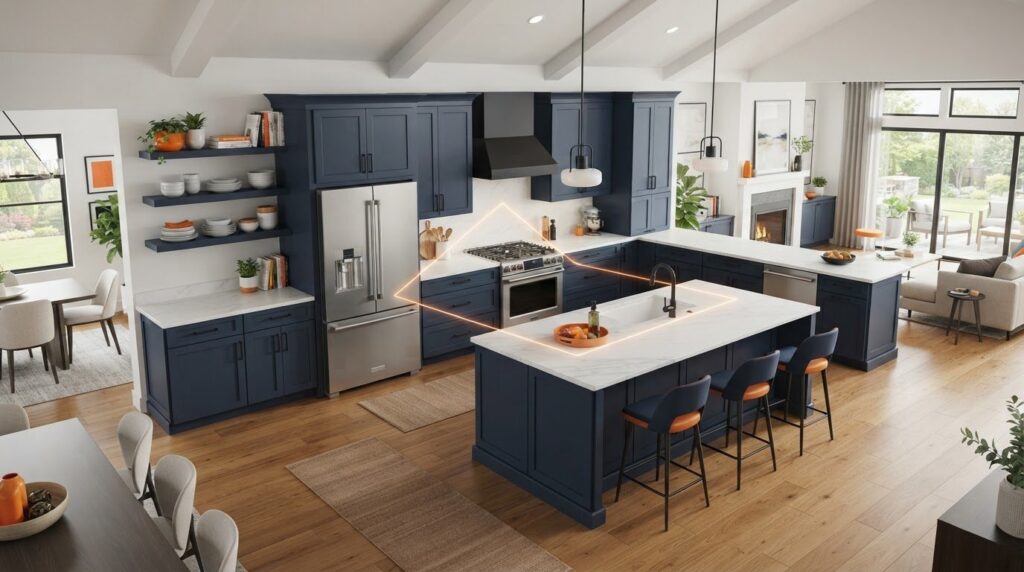
Accurate measurements are the starting point. Record wall lengths, ceiling height, door and window locations, and the position of existing plumbing and electrical connections. A designer can use those details to plan a mix of base and wall shaker cabinets for the available footprint, while accounting for appliance clearances and how you move through the kitchen. The classic kitchen work triangle refers to the relationship between the sink, cooktop, and refrigerator. Cabinet placement should support convenient movement among them, not obstruct it.
Turning Measurements into a Functional Layout
Small measurement errors can affect how cabinets fit around corners, openings, and appliances. Professional kitchen design gives you a chance to review the proposed layout and resolve questions before purchasing. A designer can plan the sink and dishwasher positions in relation to existing plumbing, but confirm final locations and utility requirements with the appropriate trades before installation. Vanity shaker cabinets serve bathroom projects, while base and wall shaker cabinets are used in kitchen layouts.
Visualizing Your Project Before You Buy
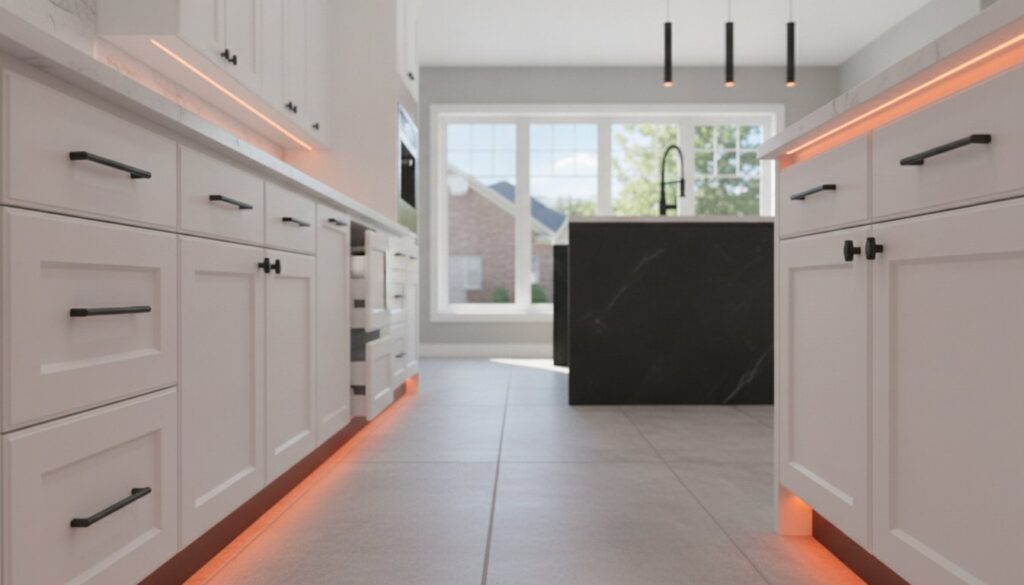
Some design processes use renderings to help homeowners picture cabinet placement and finishes before ordering. Ask what visual tools are included, and treat a rendering as a planning aid rather than a substitute for checking measurements and specifications. Comparing finish samples with your flooring, counters, and natural light can also help you evaluate your choices. Design support can help you weigh these details and plan for the finished room.
That guidance is especially useful when sourcing through wholesale cabinet supply: the value comes from pairing a considered cabinet choice with a layout that suits the room. DIY Depot USA offers professional kitchen design alongside base and wall shaker cabinets, helping customers plan the kitchen before moving ahead with their selection. For bathroom storage, vanity shaker cabinets provide a matching style option.
To discuss your layout and cabinet plans, book a kitchen design appointment.
DIY Depot USA: Your Trusted Partner for Wholesale Cabinet Supply
Wholesale cabinet supply should make it easier to access value and practical support, not leave you to sort out every decision alone. DIY Depot USA offers shaker cabinets at warehouse-direct prices, along with professional kitchen design, assembly, and installation services. The options can support homeowners planning a renovation as well as professionals sourcing cabinets for a project.
The selection covers core cabinet types for kitchens and bathrooms: base shaker cabinets, wall shaker cabinets, and vanity shaker cabinets. That gives you a consistent door style to work with across different rooms. Before ordering, compare the specifications for the cabinets you need, confirm measurements against your approved layout, and check the delivery details for your order. Direct free delivery is available in select areas, so confirm whether it applies to your location.
For contractors, property owners, and other project professionals, sourcing cabinets through one supplier can simplify product selection across multiple spaces. A multi-unit project or renovation plan may call for several cabinet types, but quantities, timing, and specifications still need careful coordination. Confirm the details for each order rather than assuming all cabinet configurations or delivery arrangements are identical.
Support Beyond the Cabinet Box
Not every buyer wants to assemble cabinets or manage installation themselves. DIY Depot USA offers assembly and installation of its shaker cabinets, giving customers the option to take a more hands-off path. Homeowners can also use professional kitchen design support to plan cabinet placement before purchasing. These services connect product selection with the practical steps that follow.
Warehouse-direct pricing can help reduce the retail markup built into some buying channels, while design guidance can help you make a considered choice. Ask questions about cabinet specifications, delivery, assembly, and installation as you plan. That way, you can compare the full scope of your project and decide which support fits your needs.
Browse DIY Depot USA’s shaker cabinets to explore base, wall, and vanity options. If you’re ready to work through your kitchen layout with a design professional, book an appointment with the design team.
Choose Cabinets with Confidence
A successful cabinet purchase balances price, construction, and a layout that works for your home. Compare materials and hardware before deciding, then weigh the convenience of pre-assembled cabinets against the potential savings and effort of RTA. With wholesale cabinet supply, a lower price is only part of the value. Professional design support can help you plan a functional fit before you order.
DIY Depot USA brings warehouse-direct pricing on shaker cabinets together with professional kitchen design support. Base, wall, and vanity options suit different rooms, while assembly and installation services are available for customers who want help beyond the purchase. Delivery options vary by location, so confirm what’s available for your order.
Ready to explore your options? Shop wholesale shaker cabinets at DIY Depot USA and take the next step toward a well-planned renovation. Compare the cabinet details and support available for your project before you order.
Frequently Asked Questions
Do I need a contractor license to buy from a wholesale cabinet supplier?
Not necessarily, but requirements can vary by supplier and purchase arrangement. Before placing an order, ask whether the supplier has trade-account rules, minimum quantities, or documentation requirements. If you’re buying cabinets for a home renovation, check the seller’s terms directly rather than assuming the word “wholesale” means a license is required. For licensing or permit questions related to the renovation itself, consult the appropriate local authority.
What is the difference between wholesale cabinets and stock cabinets at big-box stores?
Wholesale describes a purchasing channel or pricing model, while stock describes cabinets made in standard sizes and configurations. The terms aren’t opposites: stock cabinets may also be sold through wholesale channels. Compare the actual product specifications, available sizes, materials, hardware, included components, delivery terms, and support. That gives you a clearer basis for comparison than the store label alone, especially if you need a particular layout or help planning the order.
How much can I actually save by purchasing wholesale shaker cabinets?
There’s no single savings percentage that applies to every wholesale order. The total depends on the cabinet selection, assembly needs, delivery, and other order terms. For context, Kitchen Cabinet Kings reported in its July 2026 guide that RTA cabinets cost 15% to 20% less than pre-assembled cabinets. That comparison is not a guaranteed wholesale discount. Request comparable quotes and review the full project cost before deciding.
Are wholesale cabinets made from lower-quality materials?
Not automatically. Wholesale describes how cabinets are sold, not what they’re made of, and construction can vary between options. Ask for written details about cabinet-box panels, door and drawer construction, joinery, finish, and hardware. For example, confirm whether a component uses plywood or particleboard rather than relying on a broad “premium” label. Comparing specifications helps you judge value before ordering.
Can I get my wholesale cabinets delivered directly to my home or job site?
Direct delivery may be available, but confirm the destination and terms with the supplier before ordering. DIY Depot USA offers direct free delivery in select areas, so check whether your address qualifies and clarify where the shipment will be delivered. Ask about access requirements, unloading arrangements, and how to inspect the order on arrival. Delivery options can differ by location and order, so get the details in writing.
How long does it typically take to receive a wholesale cabinet order?
There isn’t a single delivery timeframe that applies to every supplier or order. Timing can depend on cabinet availability, order details, shipping arrangements, and destination. Ask for the current estimated timeline for the specific cabinets you’re considering, and confirm when the estimate begins. If your renovation has a planned installation date, leave room for delivery and inspection before scheduling work. Don’t treat a general estimate as a guaranteed arrival date.
What happens if a cabinet arrives damaged during shipping?
The next steps depend on the supplier’s shipping and damage policies. Inspect the delivery as soon as it arrives, compare the boxes and contents with your order, and take clear photos of any visible damage. Contact the supplier promptly using its stated claims process, and keep packaging and paperwork until you receive instructions. Before ordering, ask how damage should be reported and what information the supplier needs to review a claim.
Do wholesale suppliers offer design help for small kitchen layouts?
Some do. DIY Depot USA offers professional kitchen design support, which can help you plan cabinet placement for a compact layout and make better use of the available space. Gather accurate measurements, appliance dimensions, and the locations of doors, windows, and existing utilities before discussing your plan. Ask what information the designer needs and what the design process includes, so you know how the guidance can support your cabinet selection.