
What if the most expensive part of your bathroom remodel isn’t the vanity itself, but the hidden plumbing work tucked behind the cabinet? It’s common to feel a bit of sticker shock when you realize that the bathroom vanity installation cost involves much more than just a piece of furniture. You want a beautiful, functional space, but the fear of overpaying for labor or hitting unexpected plumbing snags can make the process feel stressful. It’s often hard to tell if you’re getting a fair deal when quotes vary so much between different styles and setups.
We believe that home improvements should be empowering, not exhausting. This guide will help you master the math behind your upgrade with a clear breakdown of labor rates, material expenses, and smart sourcing strategies. You’ll learn how to navigate the 2026 market with ease. We’ll compare RTA and pre-assembled options, explain how different styles impact labor difficulty, and provide a realistic budget template to ensure your project stays on track. By the end, you’ll have the confidence to choose the right products and professional support for a successful renovation.
Key Takeaways
- Learn the three main pillars of your bathroom vanity installation cost, including the unit itself, professional labor, and supplemental materials.
- Identify how vanity size and plumbing complexity can shift your total estimate, especially when moving supply lines or drains.
- Weigh the “risk premium” of a DIY installation against the peace of mind that comes with professional plumbing and leak prevention.
- Explore how warehouse-direct Shaker cabinets provide better durability and resale value than standard big-box retail options.
- Use our step-by-step template to measure your space and choose the right assembly style for your specific budget.
Breaking Down the Total Bathroom Vanity Installation Cost
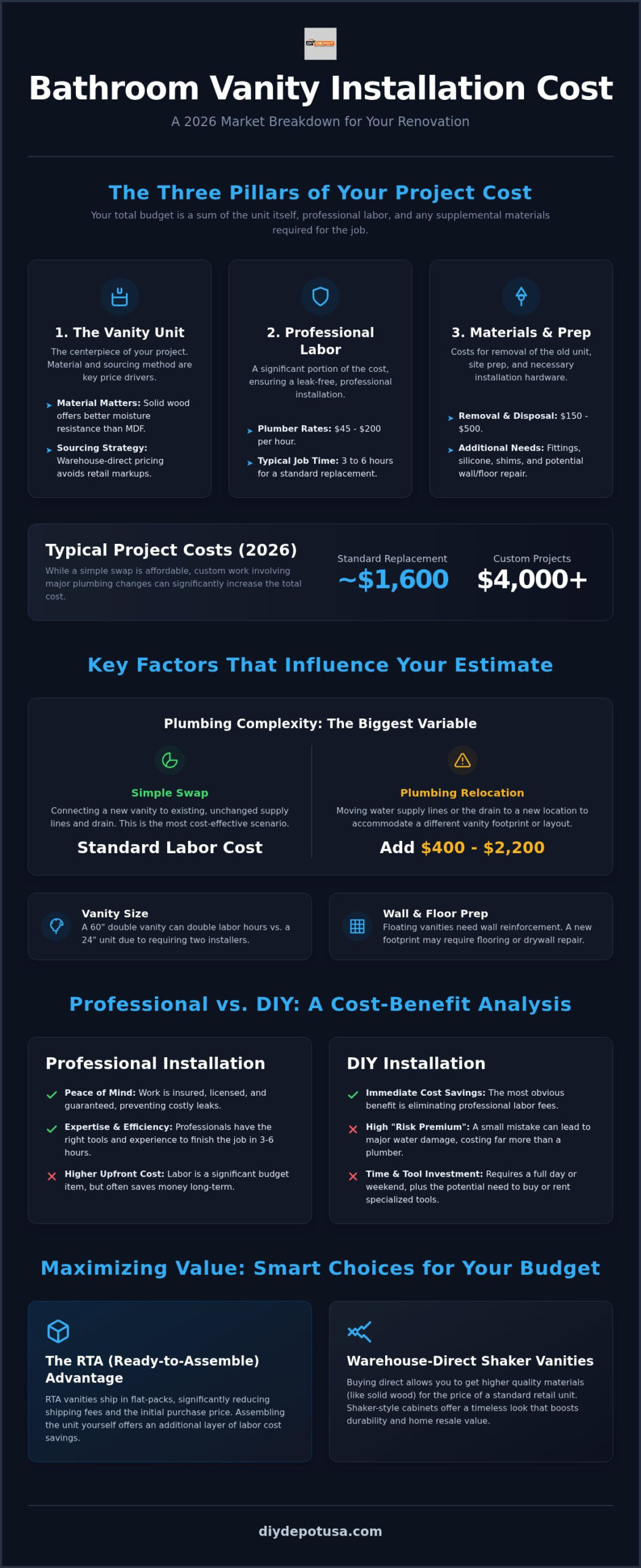
Understanding your budget starts with looking at the three main pillars: the vanity unit, professional labor, and supplemental materials. Your total bathroom vanity installation cost is the combined sum of product sourcing, site preparation, and technical labor. In 2026, most homeowners find that a standard replacement averages around $1,600. Custom projects can easily climb toward $4,000 depending on the materials and complexity involved.
A simple swap involves removing an old unit and connecting a new one to existing plumbing lines. This is much more affordable than a renovation involving footprint changes. If you decide to move the sink to a different wall, expect to add anywhere from $400 to $2,200 for new pipe runs alone. Keeping the layout the same is the most effective way to control your expenses.
The Cost of the Vanity Unit Itself
The bathroom cabinet serves as the centerpiece of your project. Choosing warehouse-direct pricing allows you to avoid the steep retail markups found at big-box stores. This often means you can afford higher-quality materials for the same price as a basic retail unit. Buying direct bridges the gap between budget constraints and high-end results.
Material choice significantly impacts the bottom line. Solid wood components offer superior moisture resistance compared to MDF (Medium Density Fiberboard), which can swell over time in humid environments. Shaker vanity cabinets remain the industry standard because they blend timeless style with rugged durability. They offer a clean look that maximizes resale value while standing up to daily wear and tear.
Professional Labor Rates for 2026
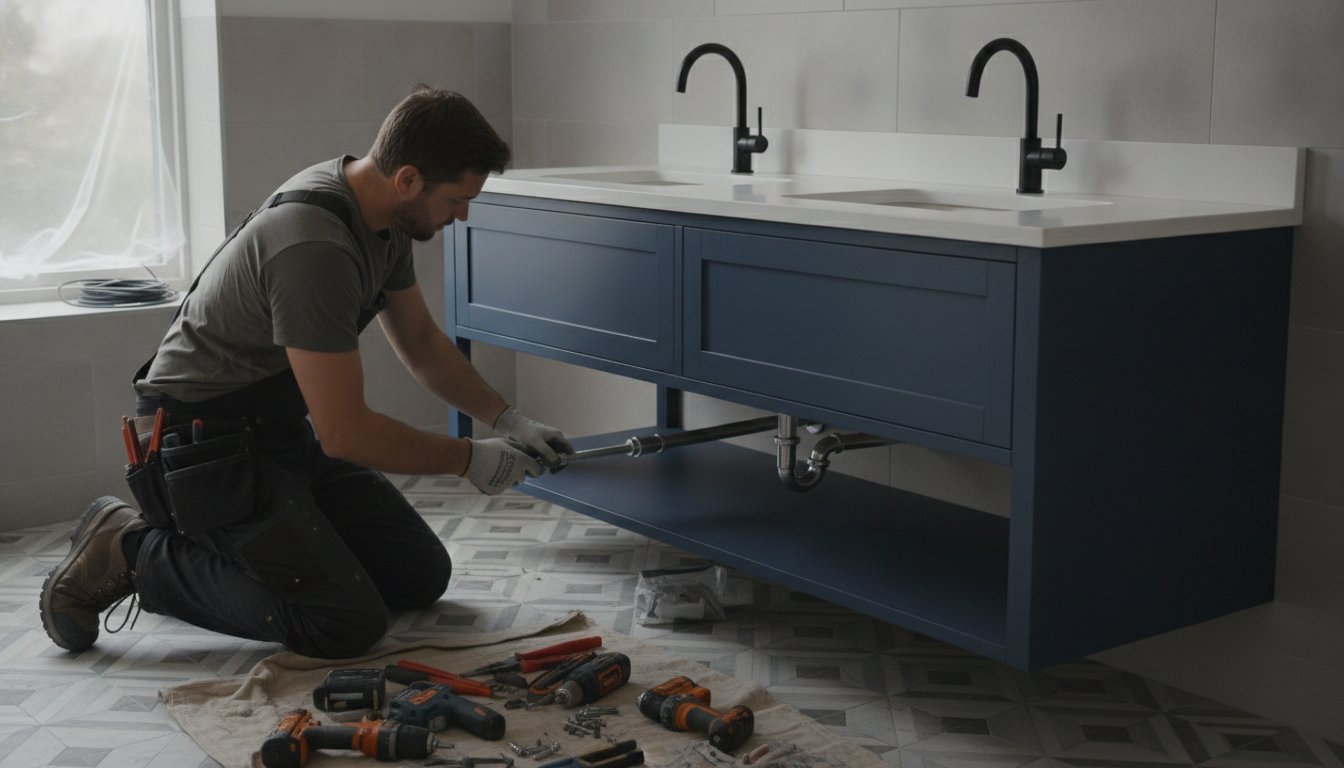
Labor typically accounts for a significant portion of the project. Licensed plumbers in 2026 generally charge between $45 and $200 per hour. Most jobs take three to six hours to complete. While a general handyman might offer a lower rate, they may not have the specialized insurance or licensing required for complex plumbing work. Hiring a specialist often prevents costly leaks later.
Most professionals charge a minimum call-out fee to cover their travel and setup time. This fee often makes small powder room projects feel more expensive per square foot than larger master bath upgrades. Geographic location also plays a role. Labor in major metropolitan hubs often sits at the top of the price range, while rural areas typically see more modest hourly rates. Getting at least three local quotes helps you find a fair price for your specific area.
Key Factors That Influence Your Installation Estimate
Several variables dictate your final bathroom vanity installation cost, and size is often the most obvious. A 24-inch powder room unit is usually a straightforward one-person job. However, a 60-inch double vanity requires two installers to lift and position safely, which immediately doubles the labor hours. Plumbing complexity is the second major driver. Connecting a new faucet to existing valves is a standard task, but moving supply lines or drains to fit a different footprint can add significantly to your bill. According to recent data, the national average cost to install a vanity varies based on these specific technical requirements.
Countertop choices also play a role in the installation timeline. Integrated tops that come pre-attached to the cabinet are the fastest to set up. In contrast, separate stone slabs like granite or quartz require careful handling and precise silicone application. If you’re looking for ways to balance quality and budget, you might consider warehouse-direct Shaker cabinets that allow you to allocate more of your funds toward premium materials rather than retail markups.
Structural and Site Preparation Costs
Before the new unit goes in, the old one must go out. Removal and disposal fees typically range between $150 and $500. If your new vanity has a smaller footprint than the old one, you’ll likely face flooring or wall repair costs. Floating vanities are popular in 2026, but they require structural wall reinforcement to support the weight of the cabinet and stone top safely. Additionally, few walls are perfectly “plumb.” Installers often spend extra time shimming the base to ensure the countertop sits perfectly level, which prevents water from pooling or draining incorrectly.
If the footprint change reveals damaged or unfinished subflooring, you can explore Project-based installation fees for resinous floor coatings to find a seamless, waterproof alternative to traditional tile that handles bathroom moisture with ease.
The RTA (Ready-to-Assemble) Advantage
Ready-to-Assemble (RTA) cabinets are a game changer for a modern budget. Because they ship in flat-packs, they reduce initial shipping costs and the overall purchase price. You can choose to assemble them yourself to build “sweat equity” and keep your bathroom vanity installation cost low. If you aren’t comfortable with tools, paying for professional assembly is a smart middle ground. It ensures a gap-free finish and structural integrity while still costing less than a fully custom-built piece. This flexibility lets you decide exactly where your time and money are best spent.
Professional Installation vs. DIY: A Cost-Benefit Analysis
Deciding whether to tackle your renovation yourself or hire a pro is a major part of the financial equation. You must consider the “Risk Premium,” which is the balance between upfront savings and the cost of potential mistakes. While you can reduce your immediate bathroom vanity installation cost by handling the labor, a single slow leak behind the cabinet can lead to thousands of dollars in mold remediation and flooring repairs. Professionals bring insurance and experience that act as a safety net for your investment.
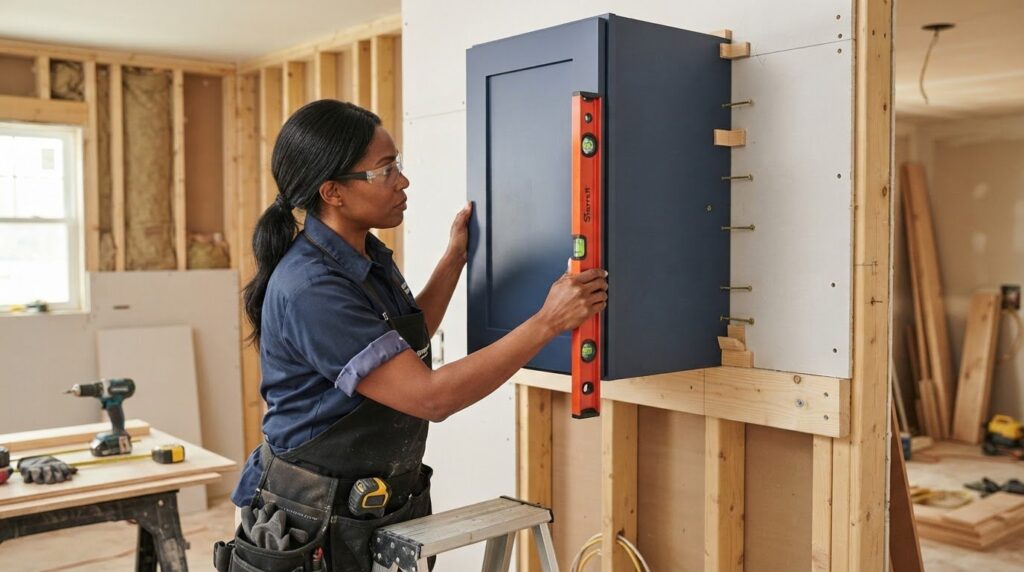
A beginner should realistically budget 8 to 12 hours for their first installation. While a pro might finish in three to six hours, a first-timer needs extra time to navigate instructions and hardware store runs. You’ll need a specific set of tools for a professional-grade finish, including a 4-foot level to ensure proper drainage, a caulk gun for waterproof sealing, and a hole saw for precise plumbing cutouts. Additionally, check your product’s fine print. Many high-end manufacturers require proof of professional installation to honor their structural or finish warranties.
When DIY Makes the Most Sense
A self-install is often the right choice for simple “like-for-like” replacements. If your new unit has an identical plumbing footprint to the old one, the technical difficulty remains low. Working with lightweight vanity shaker cabinets makes maneuvering in tight spaces much easier for a solo DIYer. These projects are ideal when the vanity is a stand-alone unit that isn’t tied into complex wall tiling or custom mirrors. It’s a great way to build sweat equity without overextending your technical skills.
When to Hire a Professional Installer
Technical complexity is the clearest signal that you need a pro. Managing double-sink configurations requires intricate drainage work that can easily overwhelm a novice. You should also call an expert when installing heavy kitchen base cabinets that have been repurposed for bathroom use, as these require specialized mounting and modifications. A professional ensures your project meets all local building codes and permitting requirements, which is essential for maintaining your home’s resale value and safety standards. Their expertise keeps your bathroom vanity installation cost predictable by avoiding the “redo” expenses that often plague unguided DIY attempts.
Step-by-Step Template for Estimating Bathroom Renovation Costs
Calculating your bathroom vanity installation cost is easier when you have a structured plan. Start by measuring your available floor space and the exact height and width of your existing plumbing centerlines. If your new vanity doesn’t align with these pipes, you’ll need to pay for plumbing adjustments. Once you’ve chosen a style, such as a timeless Shaker cabinet, decide if you’ll handle the assembly or purchase a pre-assembled unit. These initial measurements and choices form the foundation of your entire budget.
Always obtain 2 to 3 labor quotes based on a specific scope of work to ensure you’re getting a fair market rate for your area. Finally, set aside a 15% contingency fund. This money covers “behind the wall” surprises like old water damage or corroded shut-off valves that only become visible once the old unit is removed. Having this buffer reduces the stress of a renovation and keeps your project moving forward without financial delays.
Step 1: The Product Sourcing Phase
The first step to controlling your budget is comparing warehouse-direct prices against local retail showrooms. Showrooms often have high markups to cover their overhead, while buying direct allows you to get more value for every dollar spent. Check for “Direct Free Delivery” options, as shipping heavy cabinets can otherwise add a hidden expense to your total. Before you click buy, confirm exactly what’s included in the package. Some vanities come as a complete set with the top, hardware, and backsplash, while others are sold as the base cabinet only.
To start your project with premium materials at a better price point, explore warehouse-direct vanity cabinets today.
Step 2: The Labor and Logistics Phase
Drafting a clear “Scope of Work” is the best way to avoid mid-project price hikes. Tell your contractor exactly what you expect, such as old vanity disposal, new faucet installation, and backsplash sealing. A detailed scope of work keeps your total bathroom vanity installation cost from ballooning due to unexpected hourly charges. You also need to identify if you require a “plumber only” for the connections or a “full-service installer” who can handle minor flooring repairs or wall painting. Always verify that anyone entering your home has active insurance and the proper licensing for your area. This protects you from liability and ensures the work meets modern safety standards.
Maximizing Value with Warehouse-Direct Shaker Vanities
Shaker cabinets are a staple for property managers and house flippers for good reason. They offer a high-end look without a custom price tag. When you look at your total bathroom vanity installation cost, choosing warehouse-direct materials is the most effective way to ensure your money goes into quality rather than retail logistics. Unlike big-box stores that often rely on thin particle board or MDF, high-quality warehouse-direct vanities typically feature solid wood or plywood construction. This durability is essential in high-moisture environments where cheaper materials tend to swell or peel within just a few years.
Busy homeowners often find themselves stuck between wanting to save money and lacking the time to build flat-pack furniture. Professional assembly services bridge this gap perfectly. You can order your cabinets and have them professionally assembled to ensure a square, gap-free finish. This makes the final installation much smoother for your plumber or handyman. It reduces the risk of alignment issues that can drive up labor costs during the final fit-and-finish stage. Investing in a well-built unit today ensures a much higher long-term ROI by avoiding premature replacements. If you’re also planning a kitchen upgrade alongside your bathroom renovation, exploring professional kitchen design services can help you coordinate your cabinet selections and layout planning across both spaces for maximum value.
Why Shaker Style Wins the ROI Game
Shaker design is truly timeless. It appeals to a broad range of future buyers, making it a safe bet for increasing your home’s resale value. The clean lines aren’t just about aesthetics; they also make maintenance much easier. There are fewer crevices for dust and grime to hide, which is a major plus in a busy bathroom. Additionally, Shaker doors are incredibly versatile. You can completely update the room’s look five years from now by simply swapping out the hardware. This allows you to refresh the space without another major bathroom vanity installation cost down the road.
Getting Started with DIY Depot USA
Achieving a professional-grade result starts with the right planning and products. By exploring our selection of rta cabinets, you can access maximum savings while still getting the structural integrity your home deserves. We offer professional design support to help you map out your bathroom layout, ensuring every inch of space is used efficiently. This expert guidance helps prevent common measuring mistakes that lead to expensive delays. Our team is here to help you bridge the gap between a DIY budget and professional-grade results.
Browse our warehouse-direct vanity shaker cabinets today to find the perfect foundation for your next project.
Take the Next Step Toward Your Dream Bathroom
Planning your renovation doesn’t have to be a guessing game. By mastering the bathroom vanity installation cost and focusing on high-quality materials, you can create a space that looks professional and lasts for years. Remember to prioritize structural durability and keep clear communication with your contractors to avoid the common pitfalls of hidden plumbing issues or sizing mistakes. Whether you choose to handle the assembly yourself or bring in an expert, your goal is a beautiful, functional result that adds real value to your home.
We are here to make the process as simple as possible. With our wholesale prices and Direct Free Delivery in select regions, you can access premium cabinetry without the retail markup. If the technical build feels overwhelming, our professional assembly and installation services are available to bridge the gap and ensure your project is a success. You don’t have to navigate these complex tasks alone when you have a trusted local expert by your side.
Shop Warehouse-Direct Shaker Vanities at DIY Depot USA and start your upgrade with confidence today. You have the tools and the plan; now it’s time to build the bathroom you’ve always wanted.
Frequently Asked Questions
How much does it cost to install a bathroom vanity in 2026?
The national average cost to install a bathroom vanity in 2026 is approximately $1,600 when including the unit itself. Prices generally range from $300 for budget-friendly setups to $4,000 for high-end custom projects. If you are only looking at the labor for a straightforward installation of a pre-assembled unit, you can expect to pay between $141 and $461 for the professional’s time.
Do I need a plumber to install a new bathroom vanity?
You don’t always need a plumber, but hiring one is the safest way to prevent leaks and ensure code compliance. If you are simply swapping a unit and connecting it to existing valves, you might handle it yourself. However, any project involving new pipe runs or complex drainage should be managed by a professional. Their expertise protects your home from water damage that could cost thousands to repair later.
How long does it take a professional to install a vanity?
A professional typically finishes a vanity installation in three to six hours. A standard single-sink replacement is on the shorter end of that scale, while larger double vanities or floating styles take more time. If your project involves extensive wall shimming or minor plumbing adjustments, the installer might need the full day. Planning for a half-day of labor is usually a safe bet for most standard bathroom upgrades.
Is it cheaper to build or buy a bathroom vanity?
Buying a prefabricated or warehouse-direct vanity is significantly cheaper than building one from scratch. Prefabricated units often cost between $100 and $2,600, whereas custom-built vanities start at $500 for the unit alone and can exceed $12,000 for fully built-in designs. Choosing warehouse-direct Shaker cabinets allows you to get the custom look and durability of solid wood without the high price of handcrafted cabinetry.
What are the hidden costs of bathroom vanity replacement?
Hidden costs often stem from the removal of your old unit and repairs to the surrounding area. Disposal fees generally range from $150 to $500. You might also find that the old vanity’s footprint was larger, leaving gaps in your flooring or unpainted sections on the wall. Addressing these aesthetic issues, along with replacing corroded shut-off valves found during demolition, can quickly add several hundred dollars to your budget.
Can I install a kitchen base cabinet as a bathroom vanity?
You can use kitchen base cabinets as a bathroom vanity, but they require specific modifications. Kitchen cabinets are usually 34.5 inches tall, which matches the popular “comfort height” trend in modern bathrooms. You’ll need to cut the back panel to accommodate plumbing and ensure the 24-inch depth doesn’t block your bathroom door. It’s a great way to create a consistent look if you’re renovating multiple rooms at once, such as when planning a kitchen renovation Burlington alongside your bathroom updates.
Does the cost of installation include removing the old vanity?
Standard quotes for bathroom vanity installation cost often exclude the removal and disposal of your existing cabinet. Contractors typically charge an additional $150 to $500 to tear out the old unit and haul it away. It’s always best to ask for an all-inclusive quote upfront. This ensures your budget covers every phase of the project, from the initial demolition to the final bead of caulk around the new sink.
How much does it cost to move plumbing for a new vanity?
Moving your plumbing to a new location typically costs between $400 and $2,200. This price depends on how far you’re moving the sink and whether the installer needs to open up the walls or floor to reach the main lines. To keep your bathroom vanity installation cost as low as possible, try to choose a new unit that fits the existing plumbing centerlines of your current bathroom layout.